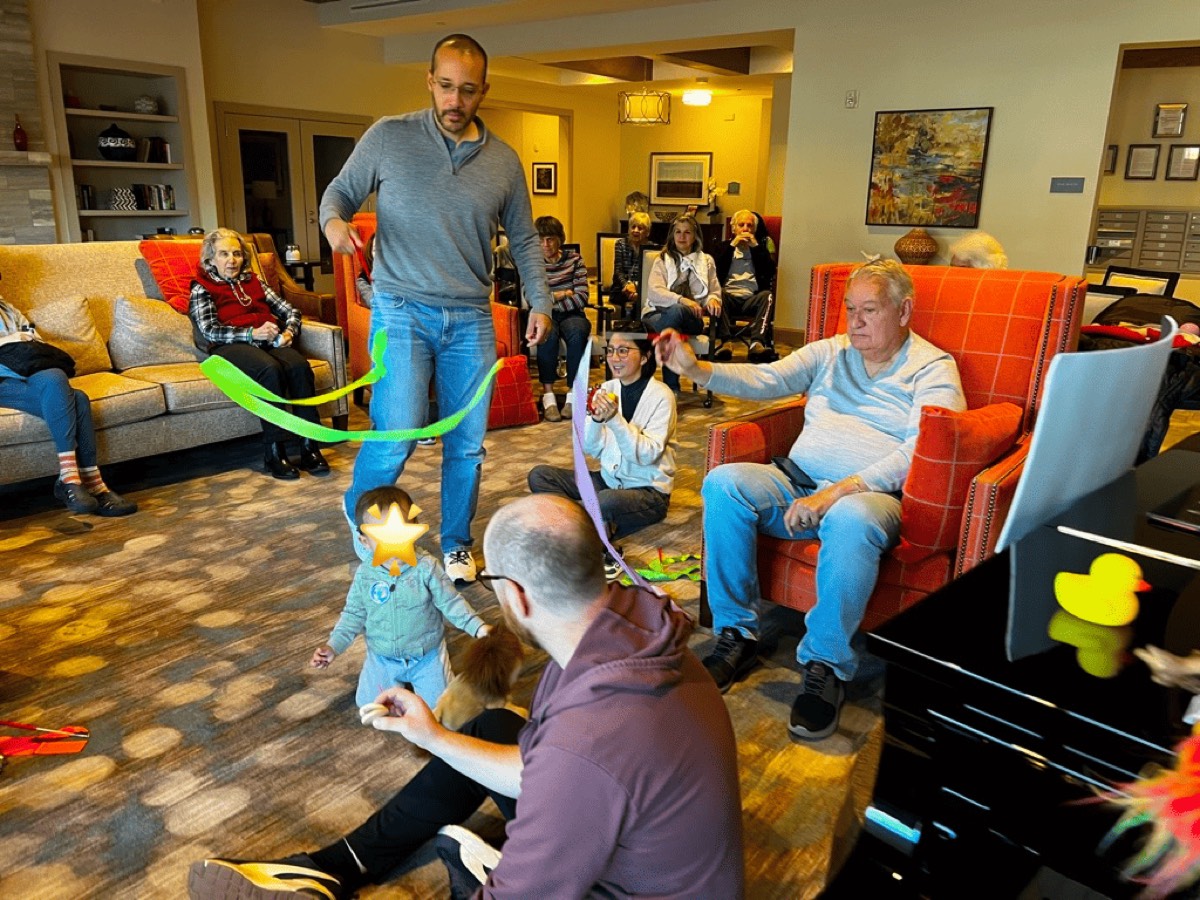
When big feelings hit, there’s no instant off-switch — not for toddlers, not for parents. But music gives us a lever. The trick is to meet the energy first, then guide it down. That’s the idea behind the Calm Dial.
Why it works
Calm isn’t something we tell kids to do; it’s something their bodies learn through rhythm, tone, and connection. Research shows that music directly affects the systems that regulate stress and emotion — the same ones we try to reach with deep breaths or hugs.
- Tempo: Fast beats meet the nervous system where it is; slower tempos invite downshifting. Studies show heart rate and breathing naturally sync to musical tempo (Sridharan et al., 2007).
- Predictability: Repeating rhythmic patterns help the brain anticipate what’s next, which lowers cortisol and restores a sense of safety (PLOS One).
- Breath and tone: Softer timbres and longer phrases cue slower breathing. When the body exhales, the mind follows.
Music also supports calm at a hormonal level. Listening has been shown to reduce cortisol, the body’s primary stress hormone, and increase parasympathetic activity — the “rest and digest” response (PLOS One; Frontiers in Psychology).
Co-regulation through sound
Before kids can calm themselves, they borrow our rhythm. A parent’s humming, swaying, or soft voice tells their nervous system, “You’re safe.” This is called co-regulation — one person’s steadiness helping another find theirs (Administration for Children & Families / OPRE).
Music is one of the simplest ways to do that. Instead of “calm down,” we can share a rhythm that says, “I’m here with you.” When the body joins the beat, connection does the rest.
The Calm Dial sequence
The Calm Dial follows the same musical arc we use in every Bach & Boogie class. It steps through three stages that mirror how the nervous system naturally unwinds:
- Vivace: one minute to meet the storm — fast, energetic, and playful. Matching energy shows understanding.
- Allegro: steady, upbeat, rhythmic — energy becomes organized movement.
- Largo: slow, warm, and grounding — the moment the body settles.
Each phase cues a different physiological response: first activation, then synchronization, then release. You can use it anytime — in the car, before bed, or after a long day. It’s not about control; it’s about giving the body something reliable to follow.
Calm isn’t taught through silence. It’s learned through rhythm, breath, and connection.
Why this matters
When children learn to downshift through music, they’re building early emotional regulation — one of the strongest predictors of mental well-being and resilience (Harvard Health Publishing).
And it’s not just for kids. Adults experience the same physiological changes: slower breathing, steadier heart rate, reduced stress hormones. Calm spreads — one rhythm at a time.
Try it now: Open the Calm Dial →